KEY INSIGHTS STATS RESEARCH
FORMULA
Across continents and seasons, the sport is beyond speed, systems — circuits, scheduling, constructors, and measurable competitive variables.The championship operates through a framework of global circuits, race distribution, seasonal scheduling, lap performance, constructor presence, and strategic variables.
IHINA PUROHIT KAISER AYAAN SANSKRITI NARAYANAN
10:02:04
FORMULA 1 is structured as a global championship, hosted across multiple countries each season.
The global circuit reflects where the sport is geographically anchored.
The concentration and spread of circuits reveal patterns of regional presence, expansion, and commercial influence.
Together, these locations form the spatial framework on which the championship operates.

CIRCUITS
hover over the map to view the circuits
CIRCUIT BY COUNTRY
ICONIC CIRCUITS
4
3
4
6
4
11
KEY INSIGHTS
Circuit distribution is geographically concentrated, with a small number of countries hosting multiple venues.
Europe remains historically dominant in circuit presence.
Expansion in recent decades reflects commercial growth in the Middle East, North America, and Asia.
Iconic circuits (e.g., legacy European tracks) persist across eras, indicating historical continuity despite calendar expansion.
RACES
OVER THE YEARS
FORMULA 1 is structured as a global championship, hosted across multiple countries each season.
The global circuit reflects where the sport is geographically anchored.
84
84
1950
1960
1980
1990
2000
2010
2020
2030
NUMBER OF RACES THROUGH DECADES
ICONIC PHOTOS DEPICTING THE HISTORY OF F1




DESCRIPTIONS
The first-ever championship race – 1950 British Grand Prix
On May 13, 1950, Silverstone hosted the first race of the inaugural Formula 1 World Championship. Over 70 laps, 24 drivers went racing in front of a crowd estimated to number up to 120,000 spectators
Four icons fight for the title – 1986 Portuguese Grand Prix
Lotus’ Ayrton Senna, McLaren’s Alain Prost and the Williams pair of Nigel Mansell and Nelson Piquet all smiled for the cameras amid a close championship fight amongst them.
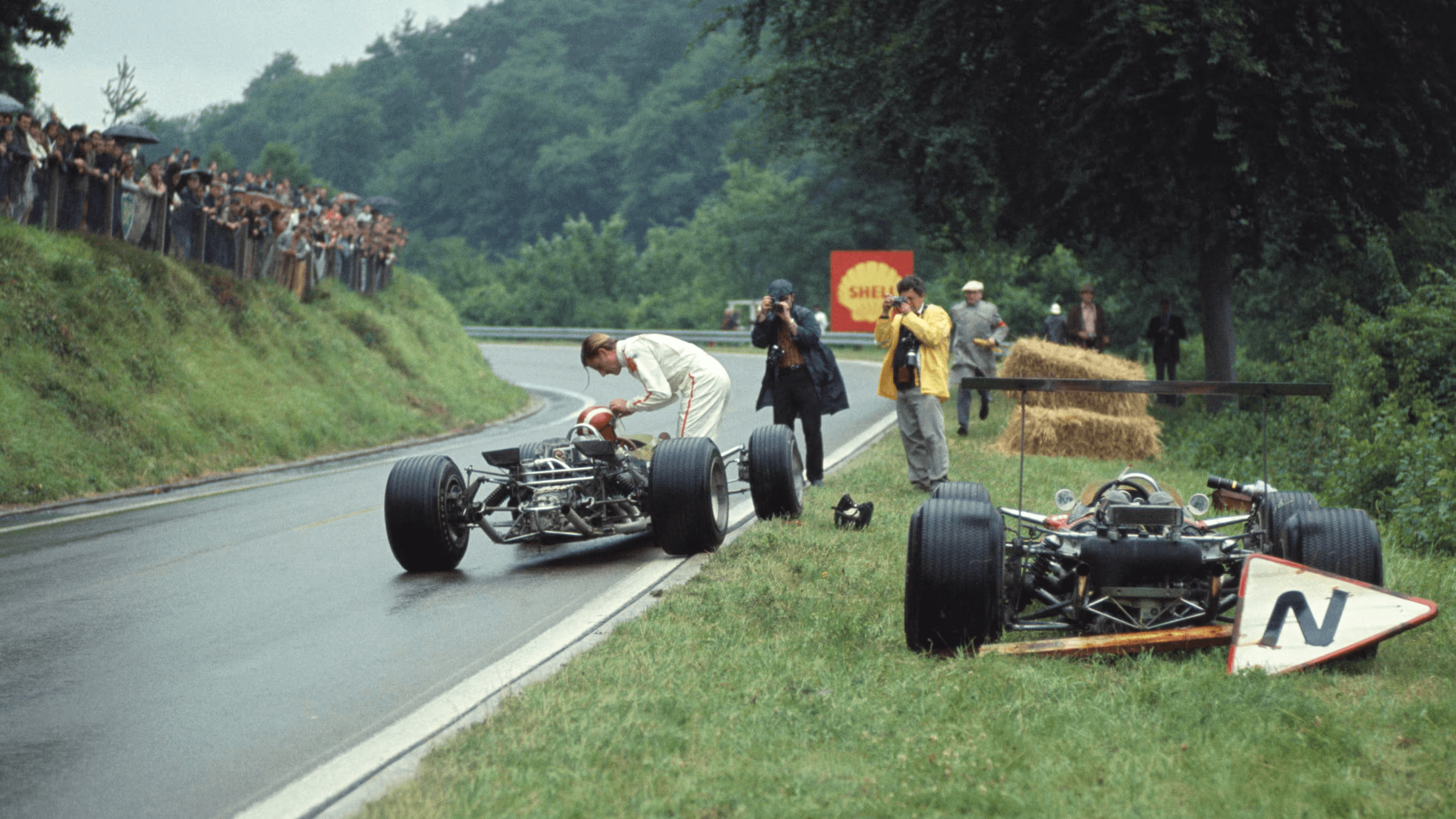
Hill lends Siffert a visor – 1968 French Grand Prix
In a race marred by the tragic death of Jo Schlesser following a crash on Lap 2, Hill retired his Lotus on Lap 14 owing to an issue with his car.
Prost walks away from infamous Senna collision – 1989 Japanese Grand Prix
Prost had to wait until 1989 for his third World Championship – which arrived in dramatic style following a controversial collision with Senna, now his McLaren team mate, at Suzuka.
Vettel bows down to the RB9 – 2013 Indian Grand Prix
After Button’s championship success, Sebastian Vettel was the next man to experience title glory for the first time in 2010, a feat he repeated three more times as he wrapped up an impressive four consecutive titles.
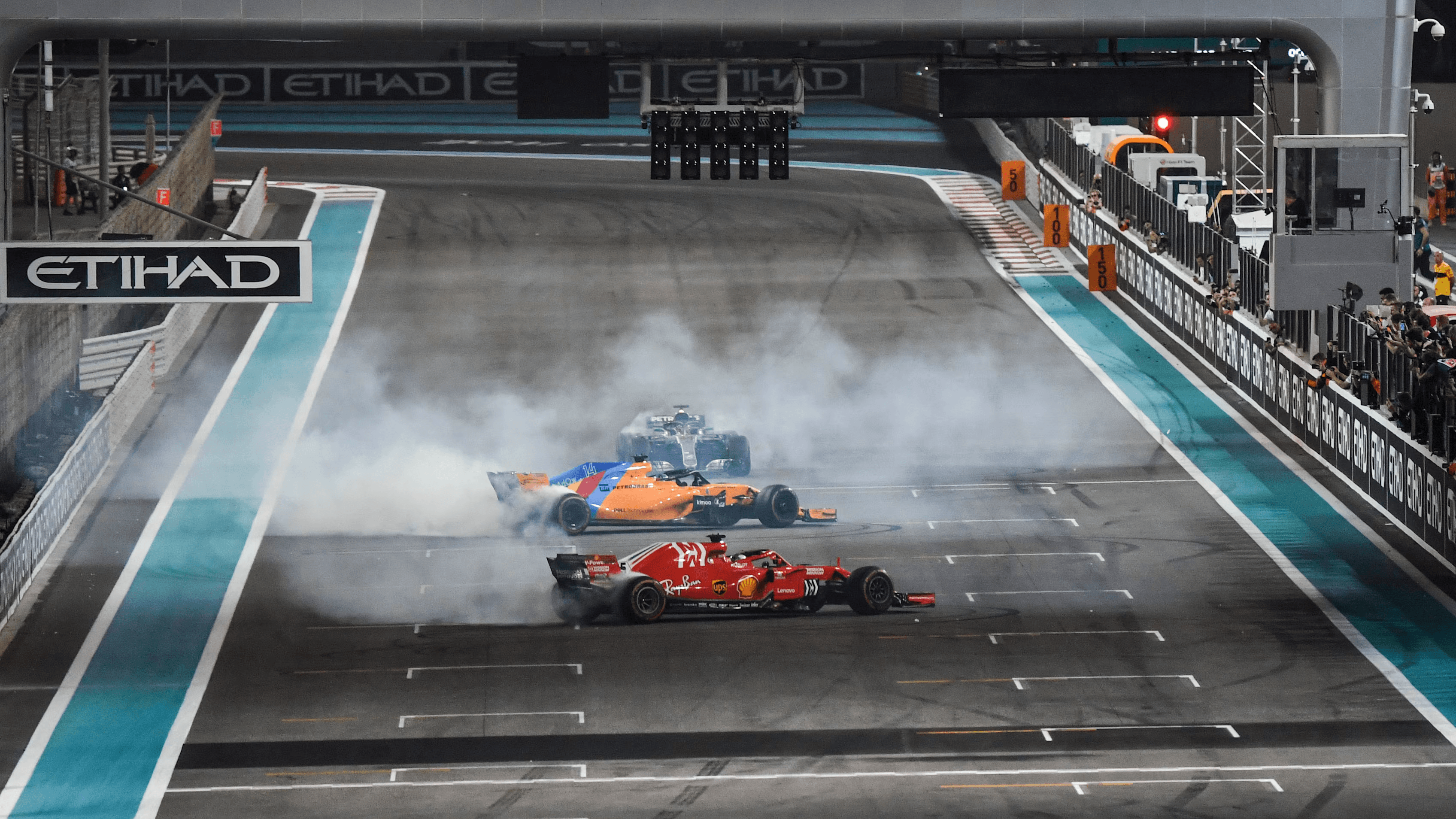
Three World Champions perform donuts – 2018 Abu Dhabi Grand Prix
While both titles had been decided prior to the 2018 season finale in Abu Dhabi – having been won by Lewis Hamilton and Mercedes – the campaign came to a close in unforgettable style thanks to a special moment after the chequered flag.
RACES PER MONTH THROUGH YEAR
SEASON DURATION BY YEAR
KEY INSIGHTS
The number of races per season has increased significantly over time, reflecting calendar expansion.
There are very less number of races between Aug-Dec, adding to it being seasonal. Many tracks cannot host races in the late-season (Northern Hemisphere winter) due to freezing temperatures or snow (e.g., Canada, Belgium, Netherlands).
August Break: A mandatory two-week, mid-August shutdown is required by the FIA for team personnel to recover.
Modern seasons are more globally distributed compared to early championship years.
From the 1980s onward, season openings progressively shifted earlier in the calendar.
In the modern era, most seasons begin consistently in March, indicating scheduling stabilization.
CONSTRUCTORS
TOP 5 CONSTRUCTORS - POINTS (1950-2025)
Constructors are the engineering foundation of Formula 1.
Each team designs and builds its own chassis, developing aerodynamic, mechanical, and structural systems within regulatory constraints. Performance is therefore not only driven by drivers, but by the design philosophy and technical capability of the constructor.
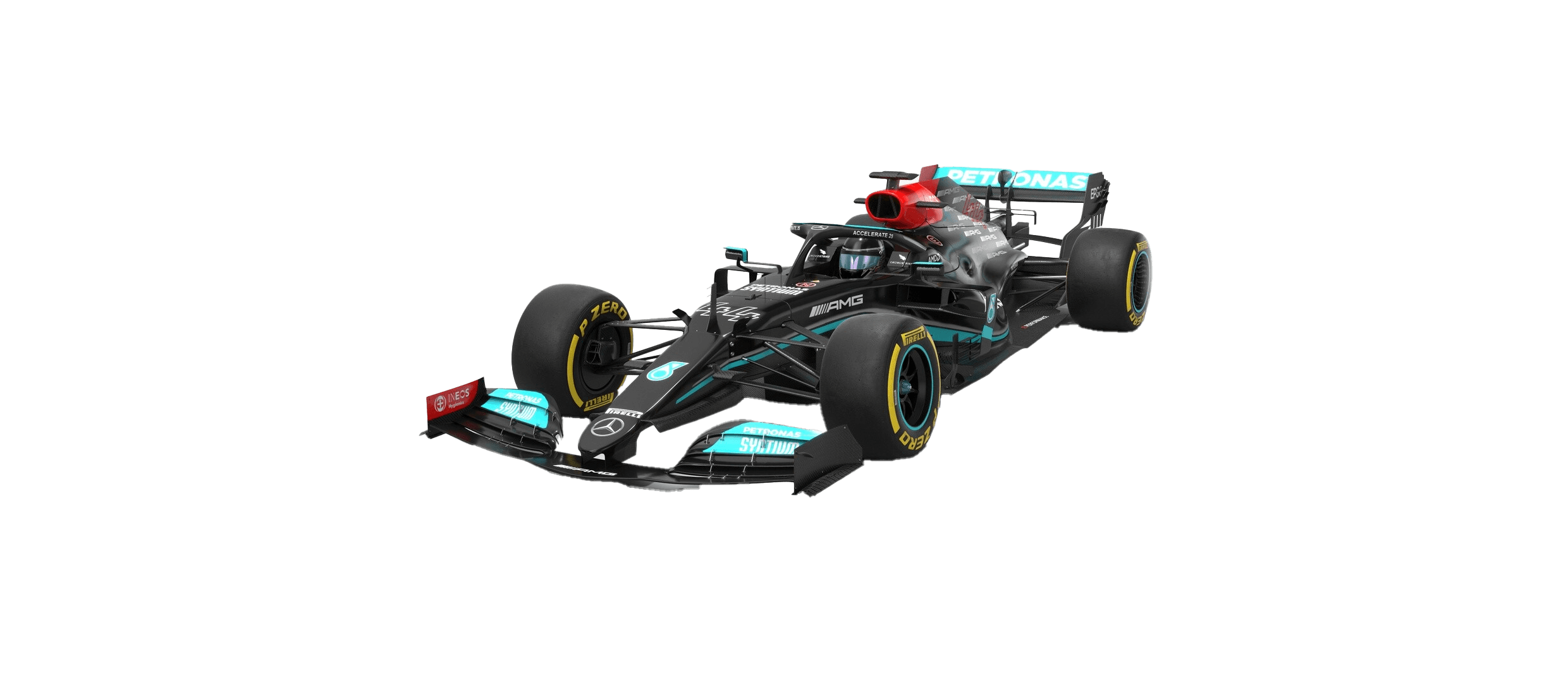
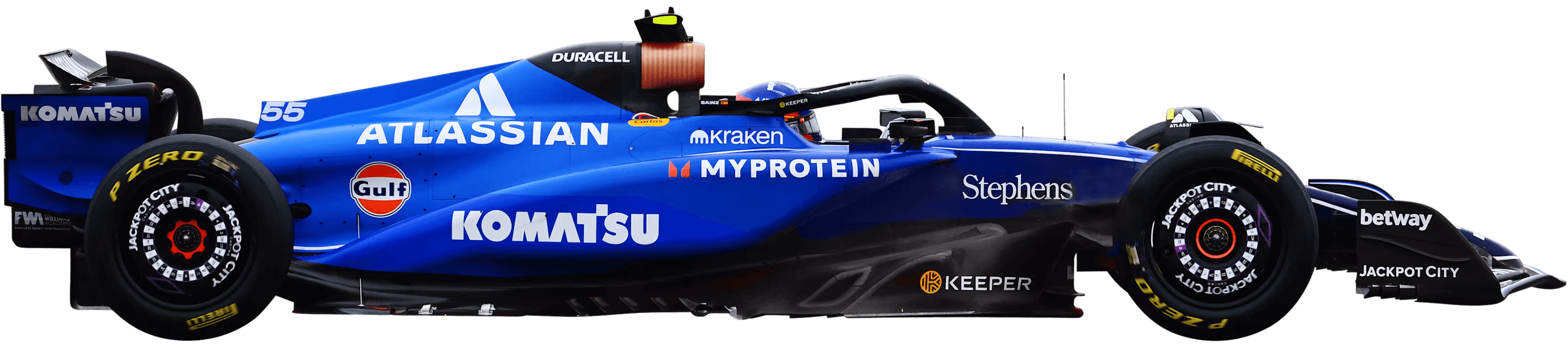
Across eras, constructor presence has shifted by country and by competitive cycle, shaping periods of dominance and transition.
hover over the constructure chips to see the trend
FERRARI

MERCEDES
WILLIAMS
RED BULL

MCLAREN

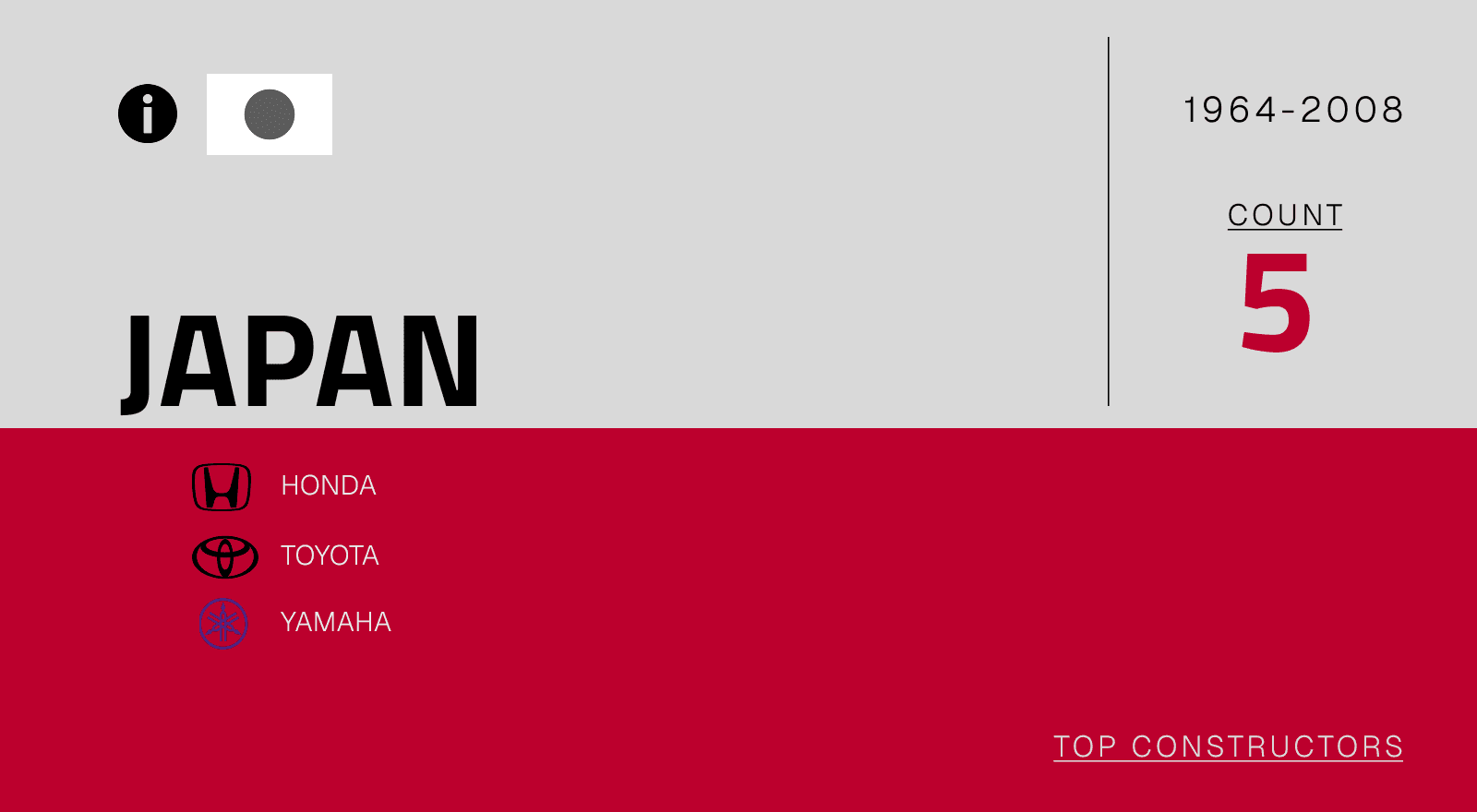
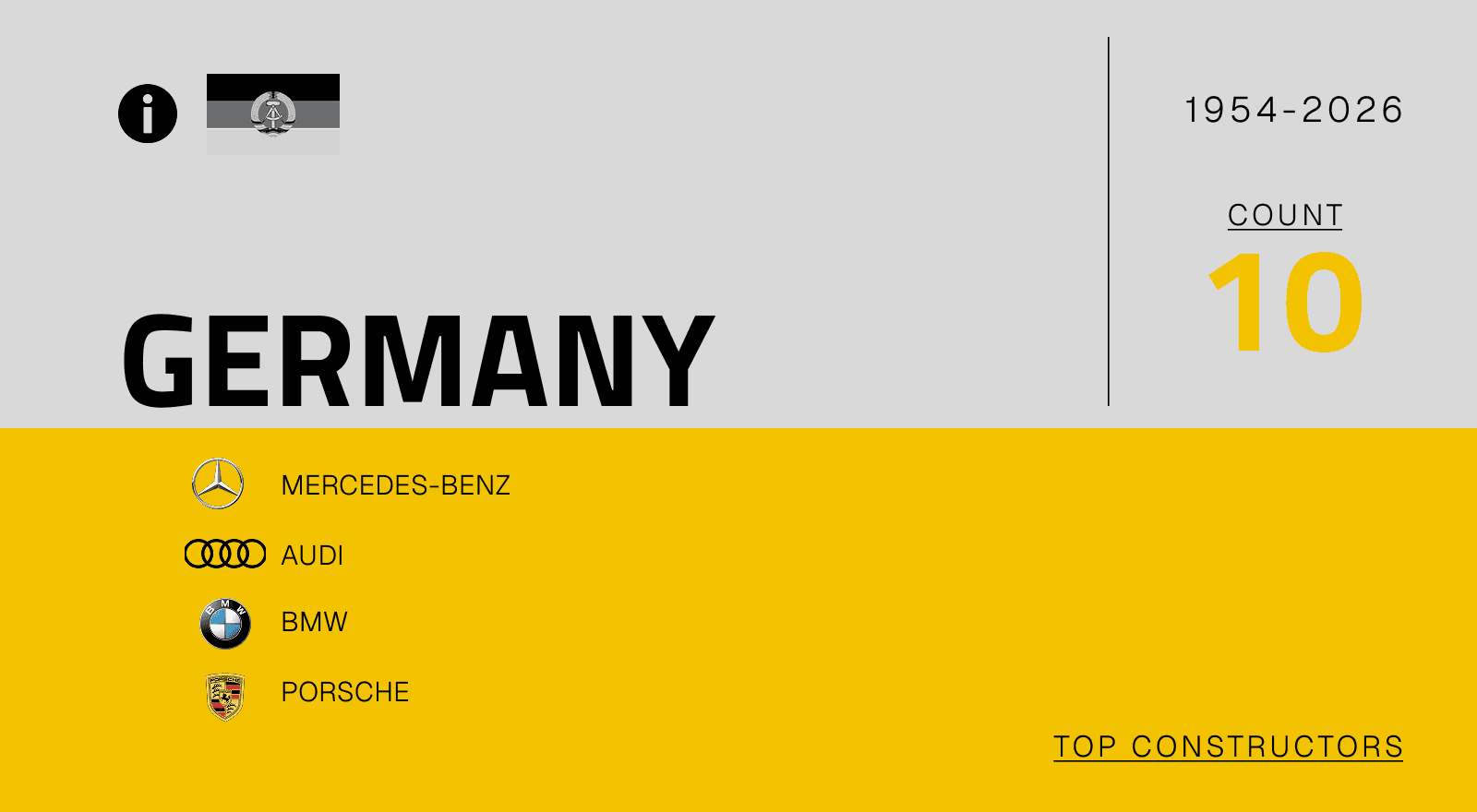
CONSTRUCTOR NATIONALITY (1950-2025)
In Formula 1, each constructor competes under an official national licence. This nationality represents the country with which the team is formally registered, regardless of where its operations are physically based.
Constructor nationality shapes the historical and geographical footprint of the championship.
VIEW NATIONALITY COUNTS









Grid Positions 2025

MAX VERSTAPPEN

MAX VERSTAPPEN
SERGIO PEREZ

MAX VERSTAPPEN
SERGIO PEREZ
CHARLES LECLERC


MAX VERSTAPPEN
SERGIO PEREZ
CHARLES LECLERC

LANDO NORRIS

MAX VERSTAPPEN
SERGIO PEREZ
CHARLES LECLERC
LANDO NORRIS

CARLOS SAINZ
MAX VERSTAPPEN
SERGIO PEREZ
CHARLES LECLERC
LANDO NORRIS
CARLOS SAINZ
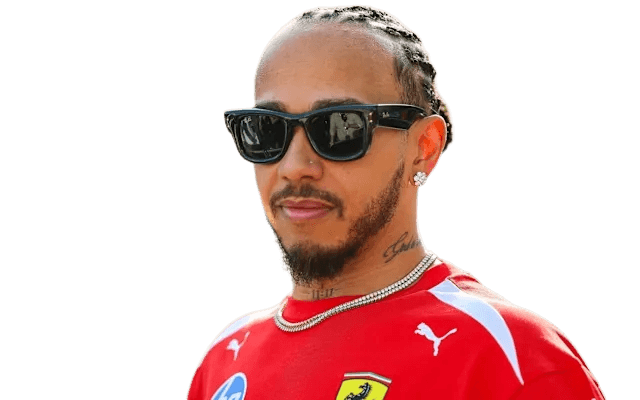
LEWIS HAMILTON
MAX VERSTAPPEN
SERGIO PEREZ
CHARLES LECLERC
LANDO NORRIS
CARLOS SAINZ
LEWIS HAMILTON
GEORGE RUSSELL


MAX VERSTAPPEN
SERGIO PEREZ
CHARLES LECLERC
LANDO NORRIS
CARLOS SAINZ
LEWIS HAMILTON
GEORGE RUSSELL
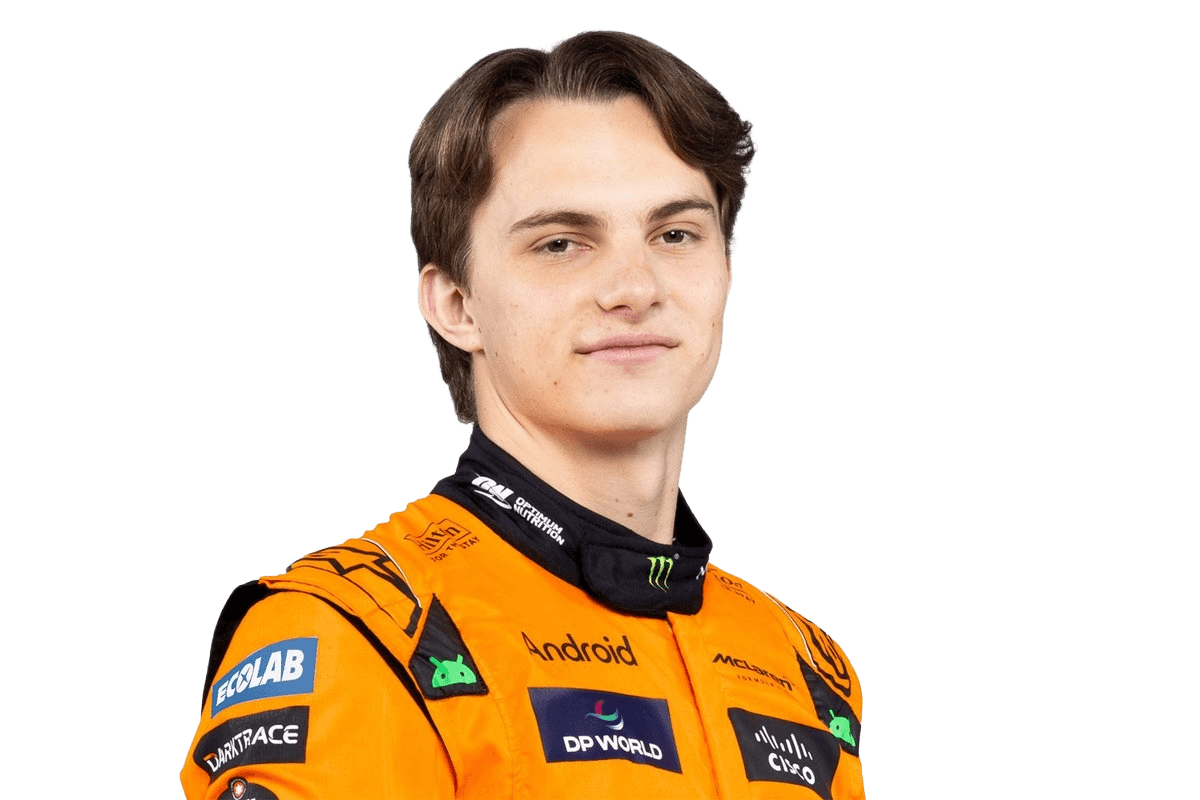
OSCAR PIASTRI
MAX VERSTAPPEN
SERGIO PEREZ
CHARLES LECLERC
LANDO NORRIS
CARLOS SAINZ
LEWIS HAMILTON
GEORGE RUSSELL
OSCAR PIASTRI
FERNANDO ALONSO

MAX VERSTAPPEN
SERGIO PEREZ
CHARLES LECLERC
LANDO NORRIS
CARLOS SAINZ
LEWIS HAMILTON
GEORGE RUSSELL
OSCAR PIASTRI
FERNANDO ALONSO
PIERRE GASLY


MAX VERSTAPPEN
SERGIO PEREZ
CHARLES LECLERC
LANDO NORRIS
CARLOS SAINZ
LEWIS HAMILTON
GEORGE RUSSELL
OSCAR PIASTRI
FERNANDO ALONSO
PIERRE GASLY
ESTEBAN OCON

MAX VERSTAPPEN
SERGIO PEREZ
CHARLES LECLERC
LANDO NORRIS
CARLOS SAINZ
LEWIS HAMILTON
GEORGE RUSSELL
OSCAR PIASTRI
FERNANDO ALONSO
PIERRE GASLY
MAX VERSTAPPEN
SERGIO PEREZ
CHARLES LECLERC
LANDO NORRIS
CARLOS SAINZ
LEWIS HAMILTON
GEORGE RUSSELL
OSCAR PIASTRI
FERNANDO ALONSO
PIERRE GASLY
LANCE STROLL

MAX VERSTAPPEN
SERGIO PEREZ
CHARLES LECLERC
LANDO NORRIS
CARLOS SAINZ
LEWIS HAMILTON
GEORGE RUSSELL
OSCAR PIASTRI
FERNANDO ALONSO
PIERRE GASLY
ALEX ALBON


MAX VERSTAPPEN
SERGIO PEREZ
CHARLES LECLERC
LANDO NORRIS
CARLOS SAINZ
LEWIS HAMILTON
GEORGE RUSSELL
OSCAR PIASTRI
FERNANDO ALONSO
PIERRE GASLY

LOGAN SARGEANT
MAX VERSTAPPEN
SERGIO PEREZ
CHARLES LECLERC
LANDO NORRIS
CARLOS SAINZ
LEWIS HAMILTON
GEORGE RUSSELL
OSCAR PIASTRI
FERNANDO ALONSO
PIERRE GASLY


VALTTERI BOTTAS
MAX VERSTAPPEN
SERGIO PEREZ
CHARLES LECLERC
LANDO NORRIS
CARLOS SAINZ
LEWIS HAMILTON
GEORGE RUSSELL
OSCAR PIASTRI
FERNANDO ALONSO
PIERRE GASLY
VALTTERI BOTTAS
ZHOU GUANYU

MAX VERSTAPPEN
SERGIO PEREZ
CHARLES LECLERC
LANDO NORRIS
CARLOS SAINZ
LEWIS HAMILTON
GEORGE RUSSELL
OSCAR PIASTRI
FERNANDO ALONSO
PIERRE GASLY
VALTTERI BOTTAS
ZHOU GUANYU
YUKI TSUNODA

MAX VERSTAPPEN
SERGIO PEREZ
CHARLES LECLERC
LANDO NORRIS
CARLOS SAINZ
LEWIS HAMILTON
GEORGE RUSSELL
OSCAR PIASTRI
FERNANDO ALONSO
PIERRE GASLY
VALTTERI BOTTAS
ZHOU GUANYU
YUKI TSUNODA
DANIEL RICCIARDO

Average Drivers per Constructor
KEY INSIGHTS
Constructor performance demonstrates cyclical dominance. Ferrari’s early supremacy, Williams and McLaren’s late-20th-century peaks, Mercedes’ hybrid-era dominance, and Red Bull’s multi-era success align closely with regulatory transitions and technical innovation cycles.
Constructor nationality reveals sustained industrial leadership by a small group of countries.
The United Kingdom and Italy maintain continuous representation, while Germany, Austria, France, Japan, and others show era-specific influence driven by manufacturer investment and strategic alignment.
EVERY LAP
DECISION
A Formula 1 lap lasts around 90 seconds. But within those 90 seconds are fuel load, tire grip, dirty air, engine modes, and split-second decisions.
is a
This is your first lap..
This is your 20th lap, your 30th lap….
>
LAPS:
0-10
LAPS:
20-30
CONSISTENCY
Fuel load has dropped significantly
Tyres are in their performance window
Field spread increases
Drivers settle into rhythm
Strategic clarity emerges
INTENSITY
Traffic congestion
Defensive driving
Cold tyres & brakes
Race incidents & safety cars
Heavy fuel load
The fastest lap, is a strategic gamble
what is the science behind this?


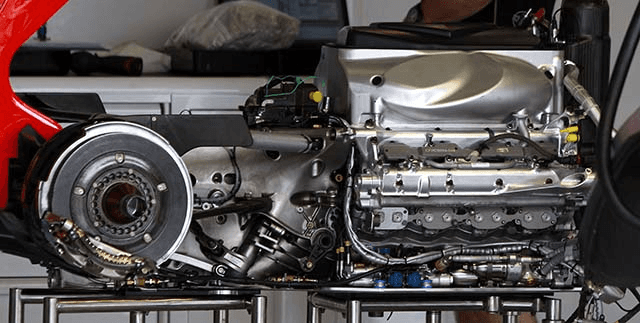

At the start of the race, cars carry approximately 100 kg of fuel. Every 1 kg costs around 0.03–0.04 seconds per lap.
This causes the speed to be 3-4 seconds slower. By mid-race, lighter cars = faster laps.
Early laps are also traffic-heavy, mid-race brings clean air and better pace.
For a brief moment, physics and performance align
THE FINAL LAP
From circuits, to lap times, we have come to the end of the race.
Thank you for scrolling till the end :)
PS: This is a work in progress